Khadi Boli Shabdkosh began in 2011 as a small collection of everyday words on a personal blog. At first, I was simply noting down the language I had grown up hearing—words spoken in homes, in fields, in marketplaces—words that carried familiarity, warmth, and memory.
While teaching as a guest faculty at Subharti University, Meerut in 2010, I began to notice a quiet shift. Many students hesitated to speak Khadi Boli. Some felt it sounded rustic. Others believed it did not belong in formal spaces. Slowly, I realized that this hesitation was not just about vocabulary—it was about identity.
When a language begins to feel smaller in public, the people who speak it begin to feel smaller too.
That thought stayed with me.
I believe that language is not merely a tool of communication; it carries history, belonging, and self-respect. When it is documented with care and presented with clarity, something changes. It can be spoken without apology. It can be heard without judgment.
What began as a modest article on my personal website gradually grew. In 2019, it became a dedicated website—a focused effort to document genuine words, meanings, and usage in an organized and reliable form.
Today, this Shabdkosh continues as an open and evolving reference—a space where Khadi Boli is preserved, understood, and spoken with confidence.
Khadibolishabdkosh.com is dedicated to restoring the linguistic dignity of Khadi Boli (Kauravi) and its speakers. While learners are welcome, this project exists primarily as an effort to document and preserve the language with clarity and cultural respect—not as a structured language course.
What Is Khadi Boli?
Khadi Boli, also known as Kauravi—and sometimes written as Khari Boli or Khāri Boli—is spoken across Western Uttar Pradesh and parts of Uttarakhand, Delhi, and Haryana.
It is also referred to as Khadi, Khadi Bhasha, or Kauravi. The authentic pronunciation is Khadi Bolli (खड़ी बोल्ली), though for simplicity this Shabdkosh uses “Khadi Boli.”
The terms Khāri Boli, Khari Boli, and Kauravi do appear in historical and linguistic discussions, though the most widely recognized and commonly used name today is Khadi Boli.
Linguistic Significance
Modern standard Hindi and Urdu developed from the Khadi Boli dialectal base.
During the Mughal period, forms of speech used in North India—structured around Khadi Boli grammar and enriched with Persian and Arabic vocabulary—contributed to the evolution of what later became standard Hindi and Urdu.
Scholars of Hindi linguistics recognize Khadi Boli as foundational in this development.
Difference Between Khadi Boli and Standard Hindi
Khadi Boli differs from standard Hindi in certain phonetic and structural patterns.
For example, the consonant ण is often used in place of न.
Thus, water is referred to as पाणी, not पानी.
Let me show you an example of ण:
One might say…
“अरै, कौण है इस कमरे मैं?”
or
“अरै, कूण है इस कमरे मैं?”
instead of standard Hindi:
“अरे, कौन है इस कमरे में?”
Also, an uncle is addressed as चाच्चा, not चाचा.
Are Khadi Boli and Haryanvi the Same?
Khadi Boli and Haryanvi are often assumed to be the same. They are not.
While some border regions show linguistic overlap, the two remain distinct in pronunciation, vocabulary, and usage.
For example:
Khadi Boli:
“तू मेरी गैल घर चल।”
Haryanvi:
“तू मेरी गैल्याँ घराँ चाल।”
Though structurally similar, each has its own phonetic identity.
Where Khadi Boli Is Spoken
Khadi Boli is spoken primarily across Western Uttar Pradesh, including districts such as Meerut, Muzaffarnagar, Saharanpur, Baghpat, Ghaziabad, Bijnor, Gautam Buddh Nagar (Noida), Hapur, and surrounding areas.
Pronunciation and vocabulary may vary slightly from region to region, but the core linguistic structure remains consistent.
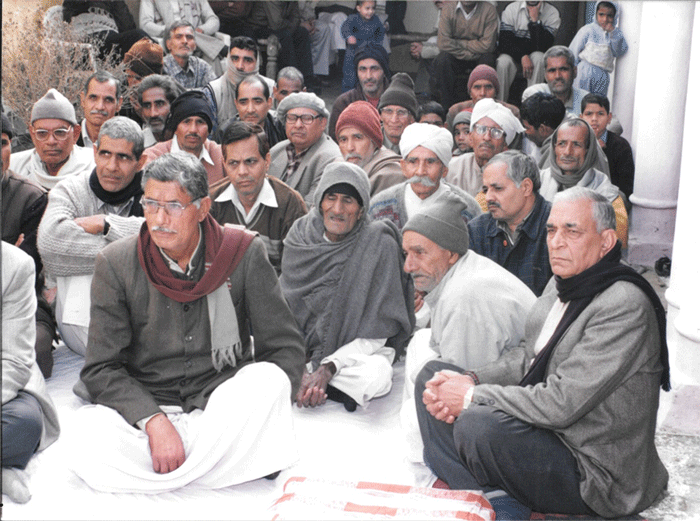
Kauravi (कौरवी)
The name Kauravi is traditionally associated with the Kauravas of the Mahabharata, as the region where Khadi Boli is spoken overlaps with areas linked to that epic narrative.
Several places connected with the Mahabharata—such as Hastinapur, Parikshitgarh, Shukratal, and Barnava—are located in present-day Western Uttar Pradesh, while Indraprastha (present-day Delhi) borders the region.
Because of this regional association, the term Kauravi is used for Khadi Boli in historical and cultural contexts.
Khadi Boli Examples
Here is a glimpse of everyday Khadi Boli words:
कट्टो (Katto): प्रेयसी | Beloved
किसी के पिच्छै कुत्ते छोड़ना (Kisi ke pichhe kuttey chhodna): किसी को बिना बात परेशान करना (ईर्ष्यावश) |
To trouble someone without valid reason (out of jealousy)
सेळक (Selak): शीतलता | Coolness
संक्कळ / सांक्कळ (Sankal / Saankal): द्वार को बंद रखने हेतु ज़ंजीर अथवा चिटकनी |
Chain or bolt used to secure a door
धूळिया-धुम्माड (Dhooliya-dhummād): धूल और धुँआ | Dust and smoke
How to Use This Shabdkosh
Explore words alphabetically using the available links. Meanings are provided in Hindi and English, along with audio samples wherever possible, to aid pronunciation.
Khadi Boli is a living language. You are welcome to explore, learn, and return whenever you need a reference.
This Shabdkosh grew out of a longer personal journey—one that includes questions of language, identity, and the quiet shame many of us are taught to carry about the way we speak. I’ve written more openly about that journey on my personal site, including why Khadi Boli is so often misunderstood.